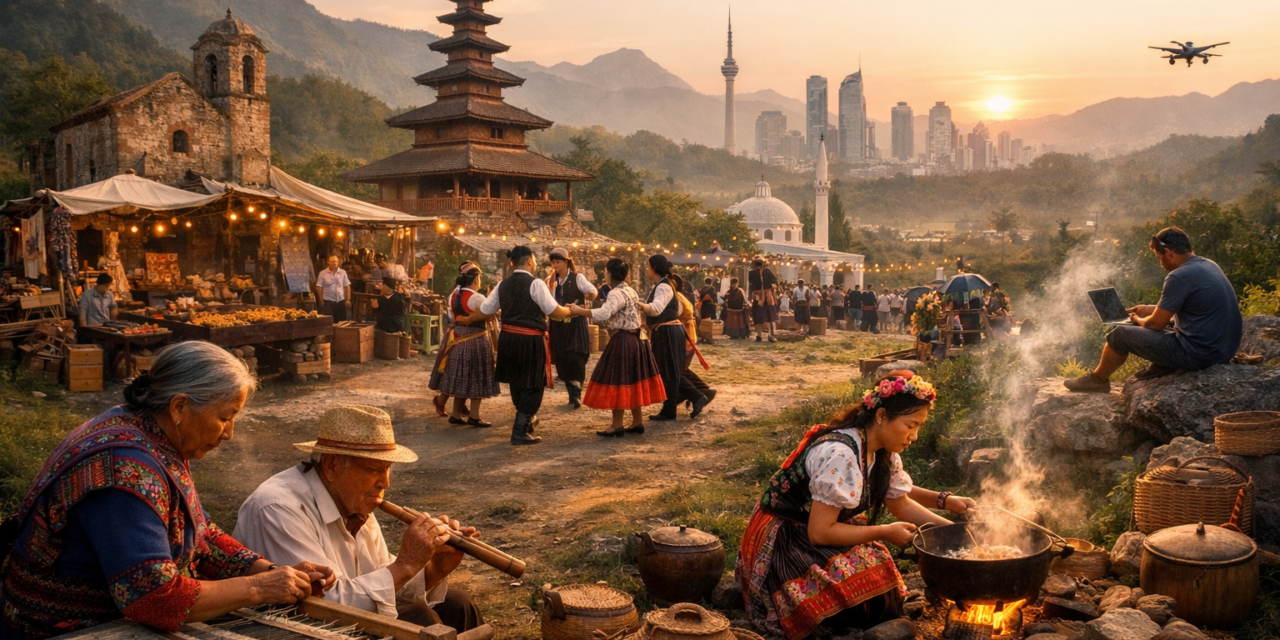
The dominant theory about globalization for decades was that the globe was headed toward a homogenous culture. Once, economists and social thinkers expected that regional identities would inevitably be destroyed by the growth of world commerce, the dominance of global media, and the widespread use of standardized technologies. Under the weight of a homogenised worldwide consumer culture, they saw a planet where unique customs, languages, and traditional arts would vanish. But lately, trends indicate that this prediction was mostly inadequate. Local cultures are undergoing a major rebirth rather than vanishing. People are growing more conscious of their particular legacy and are actively utilizing worldwide resources to maintain and restore their local identities as global connectivity rises. This phenomenon shows how globalization and local cultural assertion are intimately linked, not mutually exclusive forces. A yearning for personal belonging, the democratization of information technology, and the financial opportunities offered by cultural tourism and artisanal exports propel the rebirth of regional cultures in the present day.
The Search for Belonging in a Globalized World
The psychological need for identity and community is the main driving force behind the revitalization of local culture. People frequently feel like little components of a large, impersonal machine as the world grows more linked. The difference between locations start to fade in a time when one could buy the same brand of coffee in Tokyo, London, and New York. Many times, this perceived loss of uniqueness drives a backlash whereby individuals find solace and support in their local customs. Reconnecting with native languages, traditional festivals, regional cuisine, and local arts helps people to find a strong footing in a fast changing society.
This tendency is not only about clinging to the past; it’s also about changing what it means to belong. Many younger generations see local culture as a means of authentic self-expression. Authenticity is becoming increasingly important in a digital world full with altered photos and mainstream trends. Young individuals are more and more looking to their ancestry to set themselves apart from the homogeneous material discovered on worldwide sites. People are using their cultural heritage to create narratives that seem real and rather personal, either by the resurgence of classic clothes designs combined with contemporary sensibilities or by the preservation of regional oral histories.
Technological Empowerment and Cultural Preservation
Unlike the concern that the internet would be the main homogenizer, digital technology has become one of the most successful instruments for the preservation and advancement of local civilizations. In earlier times, language and craft survival depended on intergenerational transmission and physical closeness. Local communities may now document, distribute, and maintain their customs on a global level thanks to digital archives, social media, and online teaching platforms.
Language preservation best illustrates this technological revolution. Many languages that were formerly only spoken by a small number of older people in remote areas are now being documented thanks to apps, online forums, and digital dictionaries. Interactive platforms linking them with native speakers worldwide now allow younger generations to learn their ancestral languages. Traditional music and handcrafted methods are also being recorded via online shops and video lessons. This lets artisans from small communities interact straight with worldwide consumers who cherish handcrafted, distinctive goods. Bypassing conventional retail middlemen allows these craftsmen to keep their integrity of traditional crafts and support their families. The internet is a link that connects the local to the world market, demonstrating that technology may be a strong ally instead of an enemy of cultural variety.
The Economic Drivers of Cultural Revitalization
The resurgence of cultural heritage has also been significantly influenced by its economic advantages. Governments and local communities have progressively realized that a unique local identity is a valuable advantage in the cutthroat worldwide economy. The travel sector, where tourists are ditching mass tourism in favour of experiential travel, best illustrates this trend. Today’s travelers are frequently looking for real interactions with the local way of life, customs, and surroundings. Destinations that have kept their traditional buildings, celebrations, and culinary customs are now in a rather advantageous position.
This change to cultural tourism offers communities a financial incentive to make investments in their legacy. If a hamlet discovers that its traditional weaving designs or yearly harvest event draws foreign tourists, there is an obvious economic incentive to maintain and pass down these customs to the following generation. Furthermore, the rise of the slow food movement is yet another illustration of economic respect for regional uniqueness. People are increasingly ready to pay more for food connected to a particular region and history. This is good for local farmers and producers who grow heirloom crops and use traditional cooking methods. Converting cultural resources into commercial ones enables societies to preserve their uniqueness in a manner both lucrative and environmentally friendly.
Cultural Hybridity as a Bridge
It is vital to understand that the rebirth of local culture is not always about shutting oneself off or rejecting the outside world. Actually, among the most vivid cultural movements now are those that skillfully combine local customs with international influences. Often referred to as cultural hybridity or glocalization, this idea holds that people can incorporate local spirit into global instruments they adopt. Musicians, for instance, all across the world are fusing traditional folk rhythms with electronic production methods to produce fresh genres appealing to both local audiences and international listeners.
This hybridity denotes a thriving and flexible society. A culture that is unchanging runs the danger of losing its relevance; one that changes by integrating fresh ideas keeps it dynamic. The global age has given local artists and creatives a bigger range of inspirations to work with. Communities are not losing their culture but rather increasing its reach by using worldwide venues to highlight local concepts. This mechanism guarantees that local customs stay applicable for younger generations raised in a globalized environment. It moves the view of local culture from something dusty and contained in museums to something dynamic, evolving, and always relevant.
Challenges to Sustaining Local Identity
Notwithstanding the encouraging changes, the rebirth of local cultures faces serious obstacles. The weight of global consumerism is still a persistent issue. Big worldwide companies frequently have the means to control the cultural scene, therefore impeding local expressions from obtaining equal visibility. There is also the danger of cultural commodification, whereby customs are robbed of their significance and sold as inexpensive mementos for visitors. Often, when a deep spiritual practice or meaningful community custom is turned into a commercial commodity, the result is a hollow imitation devoid of the depth of the original.
Moreover, political instability and environmental changes endanger the very places local cultures thrive. Many native societies are inextricably tied to the land. The physical foundation for many cultural activities is endangered when forests are destroyed or environments are contaminated. Therefore, preserving local culture calls for more than only honor local holidays and crafts; it calls for preserving the environment and the political rights of local people to live on their property. The renaissance of culture remains delicate without independence and environmental stability. Native language education rules and legal safeguards protecting intellectual property and traditional knowledge against abuse are examples of institutional support needed to maintain these identities.
Conclusion
The return of local cultures in the global era is evidence of the resiliency and flexibility of human identity. Far from being paralyzed by the forces of globalization, communities throughout the world are using global connections to commemorate, preserve, and develop their legacy. This phenomenon is driven by the human need for authenticity and belonging, helped by the democratization of technology, and supported by the financial worth of cultural uniqueness. Although the dangers of commodification and corporate homogenization still exist, the trend toward local revitalization implies that humanity’s future is not one of sameness, but rather one of varied expressions coexisting in a global network.
The renaissance we are seeing now asks for a more nuanced perspective on globalization. We ought to transcend the binary viewpoint that regards the local and the global as adversaries. We should instead see them as partners in an intricate dance. Local civilizations will flourish so long as people cherish their roots and discover innovative ways to share their customs with the globe. Supporting education, safeguarding the environment, and appreciating the work of traditional craftsmen and knowledge keepers can help us to guarantee that the world stays a tapestry of different identities rather than becoming a homogeneous fabric. In the end, the viability of this cultural rebirth depends on our capacity to hug the global instruments of the contemporary era while staying strongly devoted to the customs, languages, and stories that define our own particular place in the world. Those who can live globally while acting with a great feeling of local responsibility will shape the future, hence guaranteeing our shared human history stays as varied as the many civilizations that help to create it.
Bibliography
- Appadurai, A. (1996). Modernity at Large: Cultural Dimensions of Globalization. University of Minnesota Press.
- Bauman, Z. (1998). Globalization: The Human Consequences. Polity Press.
- Castells, M. (2010). The Rise of the Network Society (2nd ed.). Wiley-Blackwell.
- Hobsbawm, E. (1992). Nations and Nationalism since 1780: Programme, Myth, Reality. Cambridge University Press.
- Robertson, R. (1995). Glocalization: Time–Space and Homogeneity–Heterogeneity. In M. Featherstone, S. Lash & R. Robertson (Eds.), Global Modernities (pp. 25-44). SAGE Publications.
- Sassen, S. (2007). A Sociology of Globalization. W.W. Norton & Company.
- Smith, A. D. (2009). Ethno-symbolism and Nationalism: A Cultural Approach. Routledge.
- Tomlinson, J. (1999). Globalization and Culture. University of Chicago Press.
- UNESCO. (2023). World Report on Cultural Diversity. UNESCO Publishing.
- Vertovec, S. (2007). Super-diversity and its Implications. Ethnic and Racial Studies, 30(6), 1024-1054.
References:
wsj.westsciences.com. Retrieved from https://wsj.westsciences.com/index.php/wsshs/article/download/250/275/1565
amt-lab.org. Retrieved from https://amt-lab.org/blog/2021/11/intangible-cultural-heritage-context-and-digital-approaches-for-safeguarding-efforts
papers.ssrn.com. Retrieved from https://papers.ssrn.com/sol3/Delivery.cfm/SSRN_ID4460861_code4762327.pdf?abstractid=4460861&mirid=1
Jorge Rodrigues Simão