Usually, in the traditional view of economics, value is assessed in terms of tangible commodities, money, and labor hours. Economists have long concentrated on the trade of actual items or digital assets with well defined market prices. But a quiet change has turned the world into what sociologists and economists call the emotional economy. Essential parts of commercial value, this sphere comprises the generation, management, and trade of emotions, sentiments, and social ties. Although emotional labor has been debated in academic circles for decades, it has only recently grown from job demands to the fundamental architecture of the internet and the world service industry. The emotional economy is an unseen market whereby human connection is the currency and personal feeling is the main product. Knowing this history is essential for appreciating how contemporary companies affect our decisions, shape our ideals, and affect our daily social contacts.
The Rise of Emotional Labor
The early 1980s saw Arlie Hochschild popularize the phrase emotional labor, which serves as the intellectual basis for the emotional economy. She noted that service industry employees were required to control their own emotions in order to deliver a positive experience for clients. A flight attendant or a customer service representative is not just selling a service or a ticket; they are also selling a certain emotional experience. Whatever their internal reality, they have to exude professional care, warmth, and patience. This expectation has gone beyond the part of the front desk clerk during the previous forty years and has seeped into practically every sphere of professional life. Employees in areas ranging from healthcare to retail are expected to conduct emotional work as a fundamental work responsibility today. This guarantees client happiness by means of a market whereby businesses essentially buy a percentage of an employee’s internal life. Here, the emotional impression left on the customer is as important as the speed of service for the economic value. The human element became the most valuable commodity as the economy moved from an industrial manufacturing economy to a service-based model.
The Algorithmic Capture of Sentiment
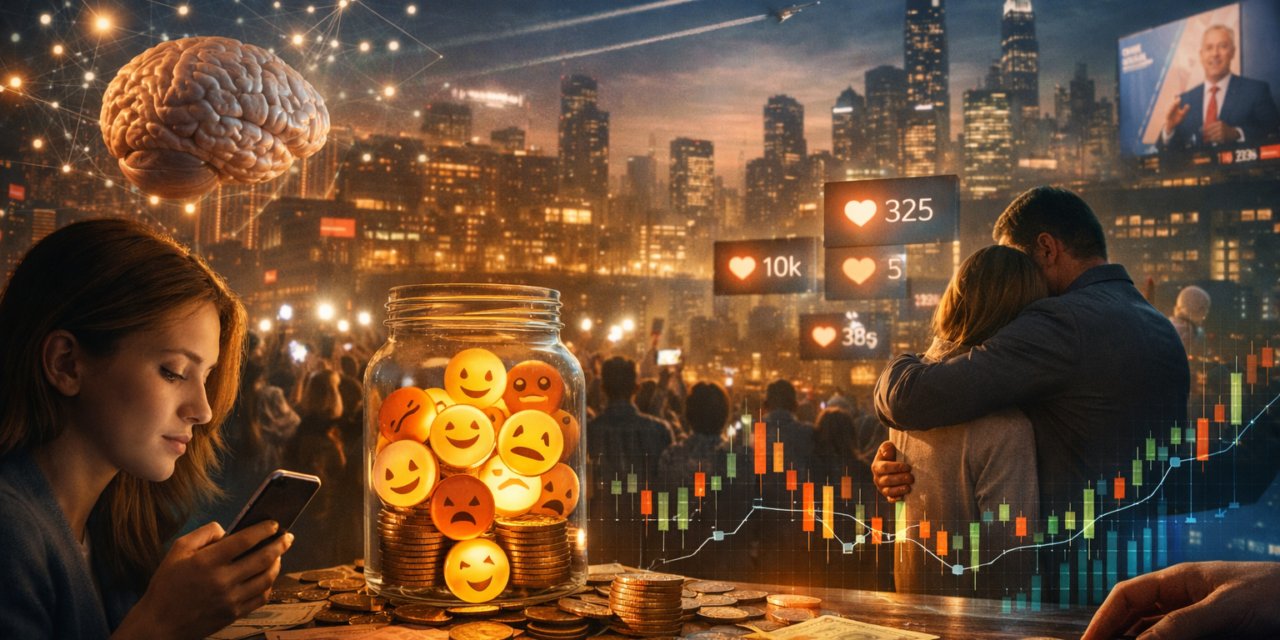
The digital architecture of social media is the main engine of the emotional economy in the twenty-first century. Facebook, Instagram, TikTok, and other platforms run on a commercial model whereby human attention and emotional reaction serve as raw resources. Users are not merely browsing material as they scroll through a feed. They are part of a feedback loop that the platform employs to improve their emotional targeting. Algorithms give top priority to material that elicits strong feelings like astonishment, anger, or happiness. By seizing these emotional data points, platforms can offer focused advertising space to businesses that know how to use these feelings to boost sales. This is how the invisible market operates. Every click, comment, and like is a vote that gives specific emotional triggers value. The market does not only look at our emotions. It shapes them. Users who get commercials based on their past emotional history are engaging in a complex system that turns the psyche into a commodity. This method generates a cycle whereby companies affect the user’s emotional condition to raise engagement, therefore providing more data for next emotional mining.
The Commercialization of Authenticity
Authenticity is in today’s world a commodity itself. Brands are turning to approaches that seem more personal and human since customers are becoming more cynical of polished business advertisements. This is why influencer culture has grown into a multibillion dollar business. An influencer adds worth by presenting a relatable version of their own life. Their fans put emotional effort into the connection; they see the influencer as a buddy or trusted counsel instead of a marketing tool. When that influencer promotes a product, the pre-existing emotional bond helps to soften the transaction. Bypassing consumers’ natural mistrust of businesses, this tactic is quite successful. The emotional economy relies on the fiction that there is no intermediate between the product and the customer. The modern creator participates in a market where trust is the main resource by transforming personal experience into a brand asset. This commodification of authenticity begs ethical issues about the blurring boundaries between real social engagement and strategic marketing. The difference between private self and public performer starts to blur when every aspect of a person’s life turns into a possible advertising space.
The Psychological Impact on Consumption
The emotional economy also influences our view of consumption. Buying a product in prior decades was frequently a practical choice depending on quality or need. Products are now often sold as answers to psychological gaps. A smartphone is not sold only on the basis of its processing capability; it is sold on the basis of the emotional appeal of connectivity, status, and self-expression. Luxury fashion companies do not only offer apparel; they also provide a sense of belonging to an exclusive community or an identity of confidence. This kind of psychological marketing makes customers examine their own feelings as part of their purchasing behavior. We eat to relieve tension, to show our belonging in a group, or to reach a certain emotional ideal pushed by influencers. This generates an endless cycle of materialism whereby the fundamental emotional void can never be permanently satisfied by a good. The market thrives on this unhappiness since it guarantees that consumers will keep looking for the next emotional lift by way of more purchases. This dynamic transforms the economy from merely a mechanism for allocating resources into one for controlling human want and worry on a large level.
The Dark Side of the Invisible Market
Although the emotional economy encourages creativity and generates new types of digital community, it also poses major dangers. The continual need to act or eat depending on emotional cues can cause burnout, anxiety, and a feeling of alienation. When humans view their emotions as goods, the inherent worth of those emotions might be diminished. Social comparison, which digital platforms increase, makes people see their own emotional lives as performances meant for public display. This continual assessment of one’s own life through the lens of outside approval generates a brittle sense of identity. Moreover, the emotional economy directly explains the polarization evident in contemporary conversation. Algorithms give divisive and controversial subjects front stage above complex debate since they favor content that creates great emotional interaction. This technology makes money from rage and fury, which are quite good at keeping consumers glued to their devices. Hence, the invisible market not only mirrors the condition of public opinion; it also actively drives society towards more extreme emotional reactions to optimize digital platform time spent.
The Future of Emotional Economic Relations
Looking ahead, the emotional economy’s reach will probably be expanded by the convergence of artificial intelligence and sophisticated sentiment analysis. To forecast customer demands before the customer is even aware of them, businesses are creating solutions that can evaluate facial expressions, tone of voice, and language micro patterns. Though this development offers a future of great ease, it also raises serious questions about privacy and personal freedom. The difference between consumer choice and outside influence becomes dangerously small if businesses can almost perfectly pinpoint and exploit our emotional triggers. At the moment, regulatory structures are battling to keep pace with these changes. While policies safeguarding consumer data frequently disregard the more ethereal matter of emotional data, which is essentially the mapping of our inner life for profit. To traverse this terrain going forward, civilization will have to foster a higher level of emotional literacy. Essential competencies for the contemporary individual include comprehending how the market tries to affect our decisions and recognizing when we are being aimed at for our emotional reactions. The purpose should be to restore the worth of real emotional experience in a society that views it as simply another ledger line item.
Conclusion
A hallmark of the current world, the emotional economy affects our daily lives, interactions, and self-definition. The market has included the human psyche into the larger economic system by turning emotions into a measurable commodity. This change has brought major difficulties even as it has made new avenues for community building and tailored experiences for consumers possible. The algorithmic categorization of erratic emotions and the commercialization of our actual selves present threats to our well-being and the integrity of our society. The first step in regaining our control over this unseen market is to understand its structure. We have to be critical of the sites we utilize and the emotional cues they use to get our notice. Fostering a more conscious interaction with the physical and digital environments will help us to guarantee that our emotional lives remain our own instead of becoming simply resources for the global economy. Whether we keep balancing convenience and control or whether we decide to establish limits to defend the integrity of human emotion will define this market going forward. In the end, the emotional economy is a mirror of our shared values, and it is up to us to determine the role our emotions should play in the overall structure of business.
Bibliography
Books and academic works
- Ahmed, S. (2014). The cultural politics of emotion. Edinburgh: Edinburgh University Press.
- Illouz, E. (2007). Cold intimacies: The making of emotional capitalism. Cambridge: Polity Press.
- Hochschild, A. R. (1983). The managed heart: Commercialization of human feeling. Berkeley: University of California Press.
- Han, B.-C. (2015). The burnout society. Stanford: Stanford University Press.
- Rosa, H. (2019). Resonance: A sociology of our relationship to the world. Cambridge: Polity Press.
- Nussbaum, M. (2010). Not for profit: Why democracy needs the humanities. Princeton: Princeton University Press.
- Giddens, A. (1991). Modernity and self-identity: Self and society in the late modern age. Stanford: Stanford University Press.
- Bauman, Z. (2000). Liquid modernity. Cambridge: Polity Press.
- Damasio, A. (1999). The feeling of what happens: Body and emotion in the making of consciousness. New York: Harcourt Brace.
- Frankl, V. (2006). Man’s search for meaning. Boston: Beacon Press.
Institutional reports
- World Health Organization. (2023). World mental health report: Transforming mental health for all. Geneva: WHO.
- (2022). How’s life? Measuring well-being. Paris: OECD Publishing.
- World Economic Forum. (2024). Global risks report. Geneva: WEF.
References:
Diversity and emotional labor in the gig economy. ouci.dntb.gov.ua. Retrieved from https://ouci.dntb.gov.ua/works/7AJZaN84/
A. Aguilar-Moreno & P. R. Palos-Sanchez & R. Pozo-Barajas (2023). Sentiment analysis to support business decision-making. A bibliometric study. www.aimspress.com. Retrieved from https://www.aimspress.com/article/doi/10.3934/math.2024215?viewType=HTML
(2023). Affective Economy: A Theoretical Outline | Encyclopedia MDPI. encyclopedia.pub. Retrieved from https://encyclopedia.pub/entry/48518
Israa Nasir (2024). The Crucial Role Emotions Play in Productivity. time.com. Retrieved from https://time.com/7201189/productivity-managing-emotions-essay/
Jorge Rodrigues Simão