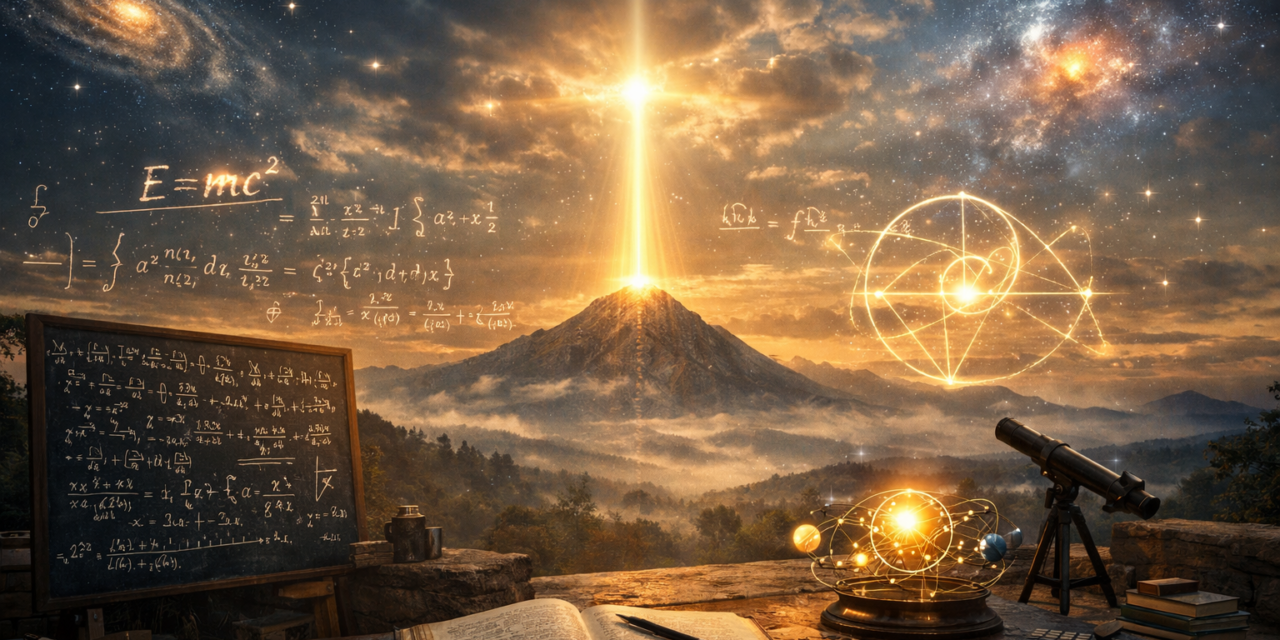
One of the most profound intellectual landscapes in human history is found at the intersection of mathematics and theology. Philosophers, mathematicians, and scientists have struggled for centuries with the issue of whether the intricate fabric of the universe may be reduced to a single, unifying principle pointing towards a transcendental origin. The search for a mathematical equation of the existence of God is not essentially a endeavor to establish divinity through variables and constants in the manner one would calculate the trajectory of a planet. Rather, it is an investigation of the structural order, the exquisite tuning of physical rules, and the fundamental rationality of the universe that implies a mind behind the veil of reality. Since mathematics is the language of the cosmos, and if that language has a structure of order, beauty, and inevitability, it is reasonable to inquire as to whether the author of that language is divine.
This paper explores the idea that arithmetic offers a link between the physical and the metaphysical. It looks into the historical roots of mathematical theology, the consequences of current cosmological constants, the character of information theory, and the philosophical difficulties connected with defining God via official logic. This research attempts to determine why the cosmos is so remarkably intelligible and whether this intelligibility is a result of blind evolutionary processes or the hallmark of a deliberate intellect by examining the works of intellectuals from Pythagoras to Kurt Godel.
The Pythagorean Legacy and the Arithmetic of Being
The most influential early proponent of the idea that number is the underlying reality of the cosmos is Pythagoras of Samos. The Pythagoreans believed the cosmos was made up of mathematical connections rather than just stuff. They came to the conclusion that music’s harmonies may be represented as basic integer ratios, therefore implying that the cosmos was under the control of a hidden mechanism. This disclosure gave rise to the teaching that everything is numbers. The source of mathematical ideas, if the physical world is fundamentally an expression of them, must therefore exist before the physical world.
God was sometimes envisioned as the Great Geometer in this old system. The harmony of numerical rules and the perfection of geometric forms were seen as proof of a divine creator. Plato was shaped by this viewpoint; he contended that mathematical objects exist in a sphere of perfect, everlasting forms. The physical world is merely a shadow of these ideal forms. This is the fundamental reason for mathematical Platonism in an academic study on the existence of God. If mathematical truths are found rather than created, they have to exist in a dimension that is not spatial or temporal. If this dimension is the basis of all reality, it suggests that the creative intelligence behind the world is fundamentally mathematical in character.
The Fine Tuning of the Universe
The discussion moved from pure philosophy to the empirical results of cosmology in the twentieth and twenty-first centuries. Physicists have found that the fundamental constants of nature, like the gravitational constant, the electromagnetic force, and the cosmological constant, are set with such incredible precision that even a tiny change would cause a universe that cannot support life. This is known as the fine-tuning issue.
The likelihood of such exact constants developing by chance is extremely low. Scientists frequently feel a feeling of wonder akin to theological meditation as they study these equations. The equation of existence in this context is found in the balancing of these forces. According to certain critics, the multiverse theory offers a naturalistic explanation whereby we just live in one of an infinite number of universes where the circumstances happened to be right. But this idea is still hypothetical and neglects to explain the source of the rules ruling the multiverse itself. Often referred to as the universe’s unjustified efficacy by Eugene Wigner, its mathematical beauty points to a coherent design. If the likelihood of a life-sustaining universe is almost zero but such a universe nevertheless exists, the mathematical model of existence must include an intelligent variable that describes the deliberate calibration of these laws.
Information Theory and the Syntax of Reality
Another lens through which to explore the mathematical character of life is information theory, developed by Claude Shannon. Information is regarded in modern computing as a basic, non-material entity. The organization of data provides the hardware meaning. Considering the biological world reveals DNA as a complex code. Biological entities are constructed in compliance with information kept in a digital format.
Life is fundamentally a manifestation of information. Thus, life requires an information source to exist. With mathematics, we may gauge how complex this data is. The Kolmogorov complexity of an item is the length of the shortest computer program needed to create it. The universe shows great degrees of complexity that are also rather ordered. This suggests the existence of algorithmically encoded data. From a mathematical standpoint, an algorithm needs a programmer. It is reasonable to suppose that a master programmer exists if the cosmos operates like an extremely complicated computer program operating on the spacetime hardware. This does not imply that God is a programmer in the strictest sense; rather, the information density of the universe calls for an intelligence beyond the physical data itself.
The Ontological Argument and Kurt Godel
The work of Kurt Godel is among the most intensive efforts to mathematically prove God’s existence. A giant of mathematical logic, Godel created an ontological proof using modal logic to show that a supreme being must exist. Godel held that a supreme being is one that has every positive quality. Using formal symbolic logic, he demonstrated through a set of axioms and definitions that if such a creature might exist, then it must exist.
Godel’s proof is a masterwork in the use of contemporary mathematical logic to address traditional theological concerns. The proof shows that the topic of God’s existence may be approached as a matter of consistency inside a logical system even as philosophers continue to dispute the validity of his axioms. It implies that the notion of a divine being has no inherent contradiction. If the framework of reality is founded on coherent logical systems, then God’s existence becomes a possibility that may be included into the great equation of existence. This contradicts the reductionist viewpoint that mathematics and godliness are mutually exclusive spheres. Rather, it locates them inside the same logical hierarchy, in which divine existence operates as a potential constant therefore validating the coherence of the whole system.
The Limits of Computation and the Incompleteness Theorem
Although mathematics provides strong instruments for investigating life, it also has internal limits that are rather important for theology. Godel’s Incompleteness Theorems showed that every sufficiently sophisticated formal system contains truths that cannot be shown inside that system. This discovery permanently altered mathematics history by demonstrating how human understanding is limited by the very systems we develop to characterize the surroundings.
This has significant theological ramifications. The universe could be an imperfect mathematical system. From inside the universe’s mathematical framework, there may be objectively true facts about existence that are mathematically unprovable. This reflects the religious notion of mystery. Maybe our mathematical language cannot fully grasp the complexity of reality since the origin of that reality transcends it. The lack of completeness in our mathematical models does not refute God’s existence; rather, it indicates that He is the source of truths beyond human computation. The equation of existence may be a function that never completely resolves in our small coordinate system, therefore suggesting a reality that is more than the sum of its components.
Mathematical Platonism vs. Physicalism
The conflict between mathematical Platonism and physicalism serves as a key tension in the mathematical quest for God. Physicalists contend that mathematics is only a tool developed by people to help in describing natural events. This perspective sees numbers and equations as simply useful abstractions, not as having any independent existence. If this is so, the cosmos has no mathematical core and every link to divinity is a human construction.
By contrast, Platonists say that mathematical objects exist apart from human cognition. If no human mind were available to count them, the prime numbers would still exist. This implies the cosmos has a transcendental structure. If this mathematical structure is fundamental to existence, then physicalism provides an insufficient account of reality. The argument between these two viewpoints is fundamentally about the nature of life itself. Accepting the Platonist perspective means grappling with the source of these abstract truths. If mathematics is not a human creation, then it is a discovery of a pre-existing structure. Theistic thinking is characterized by this order implying a designer or at least a basic logic beyond the physical world.
The Geometry of Beauty and Symmetry
Many times, mathematics is defined by its innate beauty. One hypothesis is usually preferred by physicists and mathematicians above another depending on its aesthetic merit, sometimes known as elegance. Symmetry is very important in the equations of general relativity and quantum mechanics. The universe’s preference for symmetrical and graceful laws is a topic of great philosophical curiosity.
Why does a chaotic, random process produce such beautiful and symmetrical outcomes? One would anticipate a more chaotic reality if the universe developed from purely unintentional, entropic process. The regularity and symmetry in mathematical physics imply a predilection for order above chaos. Perhaps this prejudice toward order points to an intelligent cause. Beauty and symmetry are intentional in human systems, as they stem from the use of will and design. The mathematical equation of existence probably has an aesthetic component if the cosmos possesses these characteristics. This implies that God is not necessarily a painter but rather that the fundamental laws of nature are not indifferent to the quality of the systems they generate.
The Integration of Physics and Metaphysics
One would have to combine physics and metaphysics to bring the mathematical investigation of God into harmony. While theology has investigated the meaning and purpose behind the physical mechanics of the cosmos, modern science has effectively deciphered them. The language that enables this discussion is mathematics. Writing a gravity equation is a means of articulating the behavior of the cosmos. Thinking about why gravity obeys that particular equation takes us into the realm of metaphysics.
The pursuit for a theory of everything, a single equation combining gravity, electromagnetism, and the nuclear forces, is the contemporary incarnation of the quest for the mind of God. If such an equation existed, it would show the fundamental rule of reality. The search of this idea is an acceptance of the universe as a coherent, unified entity. In classical theology, this oneness is the hallmark of the divine. The universe would be essentially monistic if all physical events can be followed back to one beginning or one rule. A monistic universe ruled by a single notion is the natural setting for a theory of a single, all-powerful creator. Therefore, the theological search for the one source of all things is closely interwoven with the mathematical quest for a theory of everything.
Probability, Chance, and Purpose
A frequent criticism against God’s existence is that the cosmos developed via chance events. From the point of view of mathematics, randomness is not the lack of order but rather a particular distribution of data. Even in systems that seem arbitrary, like the breakdown of a radioactive particle, there are probabilistic laws that govern the general behavior. This is the world of quantum mechanics, where uncertainty is a defining characteristic.
But probability itself is a mathematical idea. If the cosmos is probabilistic, then the laws of probability constitute the most basic features of reality. Is it possible for probability to exist in a vacuum? Or does it need a framework in which to run? The limits of the possible results of the universe, if it is a run of probabilistic events, are determined by mathematical necessity. This brings the conversation back to the concept of a blueprint. If the cosmos runs under a probability distribution that permits the emergence of awareness and complexity, then this distribution is not intrinsically chaotic. It is a planned route. From this angle, randomness is just a means whereby a larger, teleological structure employs it. The equation of existence might be a stochastic one rather than a deterministic one that nevertheless aims toward a particular developmental path.
Consciousness as a Mathematical Variable
Consciousness is maybe the most difficult factor in the equation of life. The scientific community has still to offer a thorough mathematical explanation for how subjective experience emerges from physical substance. This is referred to as the challenging consciousness issue. The mathematical model of the universe is intrinsically deficient if mathematics can explain all physical processes yet cannot explain the phenomena of consciousness of these processes.
Some theorists have suggested that consciousness is a basic feature of the cosmos, as actual as mass or energy. Including awareness as a fundamental variable in our equation changes the nature of reality from a mechanistic system to one that is intrinsically experiential. This bridges the mathematical and the spiritual worlds. A universe intended to promote consciousness implies a goal. If the universe thinks through mathematics, then consciousness is how it senses. In this context, a divine entity would be the sum of this consciousness, the ultimate mathematical consciousness that sustains all existence.
Critique of Mathematical Theology
One must critically examine the mathematical argument for God. Critics say that using math to prove divinity is a sort of category error. God is a theological and personal reality; mathematics is a system of abstraction and logic. They contend that a set of abstract equations cannot be used to infer a personal, loving God. The difference between the value of pi and the experience of prayer is enormous.
Additionally, critics contend that the ability of mathematics to explain the cosmos is a human accomplishment rather than a heavenly one. Humans are naturally able to see patterns because those who could see patterns in the environment were more likely to survive. Our mathematical ability results from biological adaptation, not a portal into a supernatural world. This naturalistic view presents a serious threat to the belief that the cosmos is intrinsically mathematical in a divine way. But this evolutionary explanation does not address why the cosmos, which is apart from our brains, fits so precisely with these patterns. The physical world follows mathematical laws that we discover, which suggests that logic exists independently of the human intellect. Although legitimate, the criticism does not lessen the mystery of the comprehensibility of the universe.
The Evolutionary Trajectory of Mathematical Understanding
The history of mathematics reflects an increasing capacity for human understanding. From basic arithmetic to non-Euclidean geometry and chaotic dynamics, our capacity to understand the universe has expanded exponentially. If there is a mathematical equation for God’s existence, it may be a recipe we are gradually deciphering over the millennia. Every new mathematical discovery offers a clearer view of the intricacy and regularity of the cosmos.
This implies that our quest for God is a refining process. If a supreme intelligence created the cosmos, it stands to reason that the created entities’ intelligence would finally come to see the order of the creator. One could see the progressive development of mathematics as the unfolding of a universal revelation. Learning more about the structure of spacetime and the logic of information is basically learning more about the architecture of creation. The future of this field is in the synthesis of quantum physics, information theory, and philosophy, creating a new interdisciplinary framework that can address the question of God with modern rigor.
Synthesis of Perspectives
The issue of whether there is a mathematical formula for God’s existence is complicated. It entails investigating the fabric of reality, the constants of nature, the character of information, and the boundaries of logic itself. When these strands are brought together, a picture emerges that is far more nuanced than a simple proof or disproof. We perceive a world that is inherently understandable, profoundly complicated, and essentially organized.
If it exists, the equation isn’t a fixed line in a textbook. It is a vibrant, changing process including the laws of physics, the emergence of consciousness, and the beauty of symmetry. It recognizes the gaps in our knowledge while praising our ability to comprehend. Mathematics is the tool by which we can see the divine mind if the cosmos is really the physical expression of it. It is the language that enables us to interact with the universe’s architecture, bridging the divide between the limited mind of the human observer and the infinite intricacy of creation.
The Role of Axioms in Theological Inquiry
Every system in formal mathematics starts with axioms, which are fundamental statements that are taken without evidence. These principles govern the system’s whole path. The mathematical quest for God is basically a disagreement about which axioms we elect to begin with. Starting with the premise that only matter exists, one will view the mathematics of the cosmos via a purely materialistic viewpoint. Starting with the assumption that existence is based on a transcendent reality, the same equations would be understood as the framework of divine creative power.
Crucial here is this insight. Since no mathematical system can be completely free of its fundamental assumptions, it demonstrates that mathematics does not offer an impartial, objective answer to the question of God. The decision of axioms is a philosophical one. Therefore, the search for God is a mix of existential decision and mathematical inquiry. The mathematical equation of existence reflects partly the axioms we choose as true regarding the essence of our own life. Choosing to live as though the cosmos has a purpose leads us to discover the mathematics that underpins that viewpoint. Choosing to live as though the universe is chaotic reveals the arithmetic that underpins that. Thus, the observer is reflected in the equation of existence as much as it is a road map of the cosmos.
Symmetry Breaking and the Origin of Complexity
Understanding how a basic, beautiful underlying law may lead to the intricate variety we observe in the universe depends on an appreciation of symmetry breaking in physics. The laws of physics were most likely perfectly symmetrical at first, possibly in a condition of high energy whereby all forces were united. The symmetries shattered as the cosmos cooled, resulting in the distinct forces and particles that fill our planet.
This procedure offers a powerful metaphor for the connection between God and the physical world. A singular, transcendent reality may experience a symmetry breaking process generating the manifest universe. An indispensable component of the equation of existence is the mathematical representation of this process, simple changing into sophisticated. It suggests that the complexity we see is an unravelling of the divine rather than a departure from it. The mathematical beauty comes from the fact that the whole varied, complex, and turbulent history of the cosmos may be traced back to a single point of origin. This suggests a single, deliberate source functioning as the origin of all symmetries and the engine of all changes.
Quantum Mechanics and the Role of the Observer
One of the most fascinating intersections of physics and consciousness is presented by the observer effect in quantum mechanics. According to the Copenhagen interpretation, particles only exist in a superposition of states until measured. This positions the observer at the core of the mathematical reality of the physical world. If the observer must bring the cosmos into a definite state, the issue of who or what is the ultimate observer arises.
If the cosmos needs an observer to appear, and if it existed before human awareness, then the logical conclusion is that there must be a supreme, objective observer whose existence anchors the reality of the cosmos. This might be viewed as the divine eye, the awareness that makes the physical universe possible by means of observation. This would imply that the observer’s term has to be included in the mathematical equation of the cosmos, and should the universe be objective, that observer must be a basic, universal entity.
The Beauty of Complexity and Chaos Theory
One may use chaos theory to simulate systems that are highly dependent on beginning conditions. These systems seem random, yet they are controlled by fundamental deterministic equations exposing patterns called attractors. This is a profound insight for theology: what appears to be random, chaotic, or even evil in the world may be part of a larger, orderly pattern that we are unable to perceive from our limited vantage point.
The mathematical character of chaos shows that complexity may arise from simplicity in ways that are both unforeseen and very organized. This makes it possible to create a paradigm of the cosmos whereby independence and randomness coexists with a fundamental, divine order. The equation of existence is not a clear, straightforward line; it is a complicated, fractal landscape with an endless amount of meaning. The cosmos is an abstract work of art if it is a divine creation, marked by the exquisite, recursive beauty visible in the patterns of anarchy and the intricacy of nature.
The Future of Mathematical Theology
The integration of computational power and theoretical physics will probably provide considerably more understanding of the nature of existence as we approach the future. New approaches to examine the interaction between mathematics and reality come from simulations of the cosmos, the evolution of artificial intelligence, and developments in string theory. The objective is to keep the conversation going between our perception of the world and our knowledge of the divine, rather than to complete the equation of God.
This area of research fosters humility. We are realizing that as we learn more about the mathematical structure of the world, we are increasingly confronted with the boundaries of our own perception. The future of mathematical theology rests in its capacity to harmonize these two extremes: the rigorous, empirical investigation of physical laws and the contemplative, existential quest for the source of those laws. It’s a search about the process of learning as much as it is about the destination of truth.
Mathematics as a Universal Revelation
Then mathematics is the means of its disclosure if the cosmos is really a manifestation of an intelligent source. The most significant insights have typically emerged in history by means of symbol and number. The Pythagorean harmony, the geometric perfection of the heavens, and the fine tuned constants of current physics all act as points of connection between the human mind and the divine mind.
This view raises mathematics to a holy deed. Seeking to grasp the equations that control the cosmos is involvement in the process of knowing the creator’s mind. Many great scientists who felt a sense of awe when they caught a glimpse of the inner workings of nature have explored this subject. The mathematical equation of the existence of God is not found in a single symbol, but in the total intelligibility of the world. It is the realization that the universe is a location of meaning rather than simply matter.
The Ethical Implications of a Mathematical Universe
If the universe is a mathematical system, it has consequences for values and ethics. A world founded on order, regularity, and truth implies that these qualities are not only human preferences but also basic characteristics of existence. If the fundamental nature of the cosmos is a logical, consistent system, then truth and integrity are in sync with reality itself.
This might provide the groundwork for a worldwide morality. Our deeds ought to reflect the universe’s inherent good governance by laws if we believe it does. The quest of knowledge, the search for truth, and the advancement of peace are not merely societal norms; they are our harmony with the basic nature of the cosmos. The mathematical equation of existence hence suggests a philosophy of life that gives top priority to the alignment of the human spirit with the cosmic order.
The Mathematical Model of Grace
The notion of grace, of undeserved, unearned favour, is among the most challenging ideas to fit into a mathematical universe. Mathematics is often linked to justice and necessity, where every consequence has a cause. How can the idea of grace be incorporated into a world controlled by exact equations?
Maybe grace is the exception to the norm, or maybe it is a greater order of law that we have yet to comprehend. If the universe is a system, perhaps it is one with the ability to change itself. Grace could be seen as the mathematical adjustment enabling the resetting of an entropic system. Grace might be the means by which the divine restores the coherence of a shattered world, much as a self-correcting algorithm could fix a damaged program. This adds a fresh layer to our equation: a variable for compassion or restorative intervention guaranteeing the continuous operation of the cosmic project.
The Unity of All Mathematical Systems
Mathematicians are strongly driven by the ideal of the unity of all mathematical systems, the notion that all components of mathematics are related. We are hinting at the unity of the reality they represent if we can demonstrate that arithmetic, geometry, and analysis are all branches of the same tree. This togetherness is the strongest case for a single creative source.
The mathematics of the cosmos would probably mirror that fracturing if there were many deities or many opposing forces operating. Rather, we observe a remarkable uniformity over the enormity of space and time. This oneness silently testifies to the uniqueness of the源. Therefore, the mathematical equation of existence is defined by its innate, irreducible unity.
The Search for the Missing Variable
The equation of existence remains incomplete if we consider the current state of our knowledge. Our knowledge of gravity, consciousness, and the beginning of time is deficient. These gaps are the boundaries of our investigation rather than mistakes. They stand for the locations where the divine might be most apparent, not in the established rules but in the mysteries that enclose them.
The main responsibility of next generations is to find the lost variable, the piece that clarifies how the physical emerges from the abstract, how the finite interacts with the infinite. It is a work requiring both the theologian’s openness and the mathematician’s exactness. Although the equation of existence may never be solved in terms of a final, closed system, the journey of seeking it is how we interact with the divine.
The Infinite Nature of the Divine
The idea of the infinite is a puzzle as well as a tool in mathematics. Although it is a quantity larger than any finite limit, it is utilized in computations that model the most exact physical processes. If God’s existence is a mathematical reality, it has to be connected to the idea of the infinite.
God is the infinite variable in this framework that makes all finite variables significant. The universe is the limited expression of an infinite idea. This describes our sense of wonder as we gaze at the heavens: we are seeing the finite shadow of an infinite light. Therefore, the mathematical equation of existence is a link between the physical and the spiritual, a relationship between the finite and the infinite.
The Resonance of Truth
There is a sense of resonance, a feeling that a mathematician has touched upon something real when they discover a proof that is simultaneously elegant and true. This feeling of resonance is not arbitrary; rather, it is the human experience of tuning to the universe’s reality. The subjective proof for an objective reality based in the divine is this resonance.
This resonance existence provides the mathematical formulation for God’s existence. It is the realization that our own minds follow the same logic as the universe. Our capacity to comprehend the cosmos then represents the universe comprehending itself if we are composed of the same substance as the stars and if that material obeys the laws of mathematics. This is the highest manifestation of the oneness of existence.
The Conclusion
The search for a mathematical equation for the existence of God is a quest to understand the ultimate nature of reality. Using mathematics, we have seen a structured, understandable, and progressively more reflective world from an underlying intellect. From the Pythagorean belief in the harmonic order of the cosmos to the modern cosmological findings of fine tuning and information density, the evidence points toward a reality that is not merely the product of chance.
Godel’s identification of the limits of our mathematical models reminds us that the whole of reality is outside the scope of formal reasoning. This inadequacy does not deny the divine but rather recognizes its transcendence. The universe’s mysteries are not a flaw in our calculations; rather, they are an invitation to keep the conversation going. As we explore the intricate world of physics, logic, and consciousness, we discover that our quest for the divine is reflected in our pursuit of the ultimate reality of the mathematical universe.
The equation of existence is not a fixed recipe to be mastered but rather a dynamic, evolving disclosure. It includes the symmetry of the laws of nature, the rise of awareness, and the ethereal beauty of the cosmic pattern. By conducting this investigation, we hope to expose ourselves to the profound reality that the cosmos is a deliberate, harmonious, and intelligent creation rather than to confine God. When we catch a glimpse of the mathematical truth of the universe, the resonance we sense is the work’s creative echo. Therefore, the mathematical investigation into the existence of God remains one of the most noble and important endeavors of the human intellect, acting as a link between the finite observer and the infinite Source.
Bibliography
- Gödel, K. (1995). Collected Works: Vol. III. Unpublished Essays and Lectures. Oxford University Press.
- Nagel, T. (2012). Mind and Cosmos: Why the Materialist Neo-Darwinian Conception of Nature Is Almost Certainly False. Oxford University Press.
- Penrose, R. (2004). The Road to Reality: A Complete Guide to the Laws of the Universe. Jonathan Cape.
- Davies, P. (2006). The Goldilocks Enigma: Why Is the Universe Just Right for Life? Allen Lane.
- Barrow, J. D., & Tipler, F. J. (1986). The Anthropic Cosmological Principle. Oxford University Press.
- Tegmark, M. (2014). Our Mathematical Universe: My Quest for the Ultimate Nature of Reality. Knopf.
- Craig, W. L. (1979). The Kalam Cosmological Argument. Macmillan.
- Plantinga, A. (2011). Where the Conflict Really Lies: Science, Religion, and Naturalism. Oxford University Press.
- Hawking, S., & Mlodinow, L. (2010). The Grand Design. Bantam Books.
- Chaitin, G. (2005). Meta Math!: The Quest for Omega. Pantheon Books.
References:
YouTube. www.youtube.com. Retrieved from https://www.youtube.com/watch?v=lKxCVZVBgoI
(2005). Teleological Arguments for God’s Existence (Stanford Encyclopedia of Philosophy). plato.stanford.edu. Retrieved from https://plato.stanford.edu/entries/teleological-arguments/
(1970). Gödel’s ontological proof – Wikipedia. en.wikipedia.org. Retrieved from https://en.wikipedia.org/wiki/G%C3%B6del%27s_ontological_proof
(2017). Fine-Tuning (Stanford Encyclopedia of Philosophy). plato.stanford.edu. Retrieved from https://plato.stanford.edu/entries/fine-tuning/
(2007). Philosophy of Mathematics (Stanford Encyclopedia of Philosophy). plato.stanford.edu. Retrieved from https://plato.stanford.edu/entries/philosophy-mathematics/
digitalcommons.liberty.edu. Retrieved from https://digitalcommons.liberty.edu/cgi/viewcontent.cgi?article=1165&context=sor_fac_pubs
(2026). God, arguments for the existence of – Routledge Encyclopedia of Philosophy. www.rep.routledge.com. Retrieved from https://www.rep.routledge.com/articles/thematic/god-arguments-for-the-existence-of/v-1/sections/teleological-arguments-cont
Jorge Rodrigues Simão